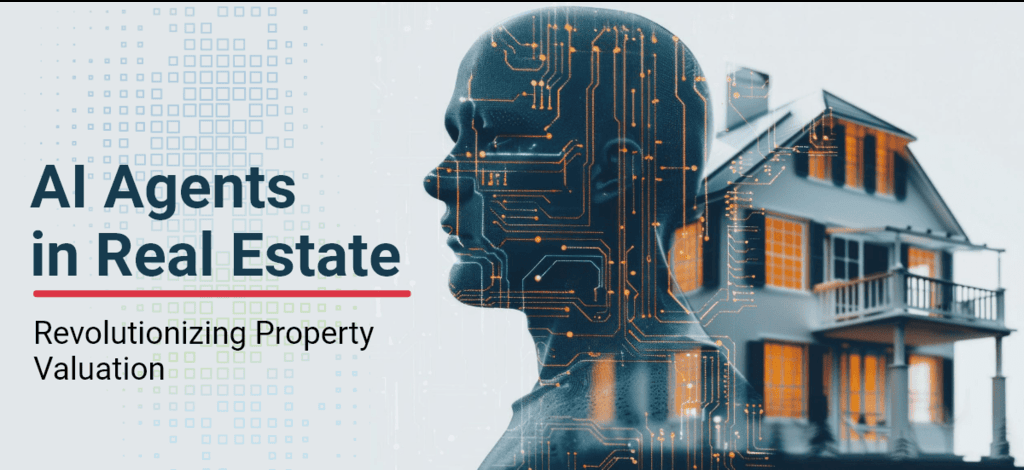
Artificial Intelligence (AI) is revolutionizing the real estate sector with a paradigm shift in property valuation and creation of market insights. The advancement in both the data available and technology capabilities has made it possible for investors, developers, sales agents, and regulators to make informed decisions faster with the help of AI solutions. Value calculations and predictions are not what AI in real estate will be in the future; rather, AI is already changing the face of real estate.
AI-Powered Property Valuation
Among the most prominent uses of AI in real estate is property valuation. Conventional property valuations are highly dependent on traditional comparing and judgment-based systems. Although traditional systems are useful and reliable, they can be time-consuming and sometimes involve errors on the judgment of the valuator. AI-based Automated Valuation Models (AVMs) process millions of data inputs within minutes. These include variables such as location, property type and characteristics, sale records, area development activities, and macroeconomic variables.
With the ability to process large datasets at a rapid pace and accuracy, AI provides a consistent and objective property valuation. This particular quality and functionality of AI become even more essential in a situation where property markets are experiencing rapid changes with valuations going up and down as a result of changes in interest rates or lack of property supply.

Revolutionary Market Insights via Big Data
Aside from valuation, AI has an important role in the transformation of market analysis. The capability of AI to process data emanating from property listing, demographic changes, migration patterns, employment growth, and shopping habits holds significant value in this process.
Using predictive analytics, AI is now capable of future forecasting, hotspot identification, and precursors for slowdowns in the market. Real estate developers use it for making informed project-related decisions, while investors use it for market entry and exit.
Informed Investment and Risk Evaluation
AI technology has also transformed the area of investing and risk management in the real estate business. Machine learning technologies quantify different factors like the return on investment from renting, vacancies, price fluctuations, costs associated with gaining finance, and weather-related risks. This enables potential investors to run multiple simulations on the market.
In the context of rising investment costs and environmental unpredictability, risk models based on artificial intelligence make it easy for investors to modify their investment strategy based on asset protection.

Operating Efficiency and Competitive Advantage
The real estate industry benefits greatly from AI-powered automation. Real estate agents can better their pricing approaches, provide customized recommendations related to properties, and perform better in marketing. Property managers leverage AI technology in forecasting their maintenance requirements, optimization of rental pricing, and improving the satisfactions of the tenants.
Conclusion
Artificial intelligence has emerged as a paradigm shift in the real estate sector by altering the means by which property valuations as well as market intelligence inputs are processed. By incorporating sophisticated valuation algorithms, predictive analytics, and improved risk analysis, AI enables more precise, faster, and more informed decision-making. Although the input or talent factor remains paramount, leaping on the technology bandwagon offered by AI offers a brilliant differentiator. In a growing more complex real estate market, the need to implement AI technology has become imperative.